
The Hidden Cost of a Brand No One Wants to Work For
A company posts a job opening. After weeks of reviewing résumés, conducting interviews, and negotiating terms, they finally find the right candidate. The offer is accepted. The new hire never shows up on day one.
They start over.
A few weeks later, they hire someone else. This time, the new employee joins the team—but resigns before the first month is over.
They start over.
By the time a third person fills the role, the department manager has already spent countless hours interviewing candidates. Human Resources has reopened the hiring process. A colleague has postponed their own work to prepare the onboarding. Projects continue moving forward, only more slowly. Clients are waiting. The team adapts once again.
Meanwhile, the agenda for the next executive meeting moves on as planned. Artificial intelligence. Marketing. Sales. Cost optimization. Digital transformation. No one asks what it costs to keep starting over.
Over the past few years, we've talked about talent shortages, the Great Resignation, remote work, and more recently, artificial intelligence, as though they were the only forces reshaping the workplace. Yet there is a much quieter phenomenon that seems to have become normal: organizations spending a significant portion of their time rebuilding themselves.
The conversation usually revolves around how difficult it has become to hire. Recruiters talk about candidates who accept an offer but never show up, or employees who leave within their first few weeks. At the very same time, thousands of professionals insist that finding a good job has never been harder. Both statements sound contradictory. They can also be true.
While some organizations struggle to fill open positions, many professionals no longer see traditional employment as the only path forward. In a recent survey of my Design students, almost none imagined building their careers inside a company. Most wanted to freelance, launch their own studio, or start an agency. Admittedly, this is far from a representative sample of the labor market. Yet it reflects a conversation that is becoming increasingly common across creative and knowledge-based professions: the company is no longer the default destination of a career. It has become one option among many.
Perhaps we are still trying to answer a new question with solutions designed for a different moment in time. We continue asking how to attract talent, even though the labor market no longer operates under the same rules it did just a few years ago.
But even if we accept that the context has changed, one far more uncomfortable question remains: What does it really mean for an organization to exist in a permanent state of starting over?
The Cost of Starting Over
When someone resigns, the first response is usually practical: open a new position, search for candidates, and fill the role as quickly as possible. Yet hiring has never been a single event. For a long time, we assumed that finding the right person meant the problem had been solved.Today, we know it's only the beginning.
Every organization goes through at least three distinct stages. The first is finding the right candidate (Time to Fill). The second begins once that person joins the team and starts learning how to perform the role (Time to Productivity, or Ramp-up). The third arrives when the value they create finally outweighs the investment made to hire them (Time to Break Even).
Each stage takes time, and that timeline varies depending on the complexity of the position. An entry-level employee may reach expected performance within a few months. A specialized professional often requires six to nine months to become fully productive. Leadership roles can take a year—or even longer—to reach the same point.
In other words, hiring someone does not mean gaining their full potential on day one. During that period, the organization invests before it sees a return.
It invests in recruitment, interviews, Human Resources, managers' time, equipment, software licenses, training, mentoring, and, inevitably, in the mistakes that come with learning. While a new employee is absorbing the business, the clients, the processes, and the culture, experienced colleagues dedicate part of their own time to teaching what they have already learned.
None of this is a problem. It is a natural part of how healthy organizations grow. The problem begins when that process never has the chance to finish.
In recent years, organizations have seen a rise in what is known as early turnover: employees who leave within their first 30, 60, or 90 days. By that point, the company has already absorbed much of the cost of recruiting, onboarding, and training, yet it has recovered very little of that investment through the value the employee was expected to create.
A few years ago, I worked with a company of roughly 150 employees that estimated turnover was costing nearly $5,000 every week. That figure accounted only for the visible costs of replacing people. The real cost was almost certainly much higher. Because the most significant losses rarely appear on a financial statement.
There is no line item for the conversations that must be repeated, the trust that has to be rebuilt, or the context that disappears every time someone leaves. And that is precisely where the most difficult cost of all begins.
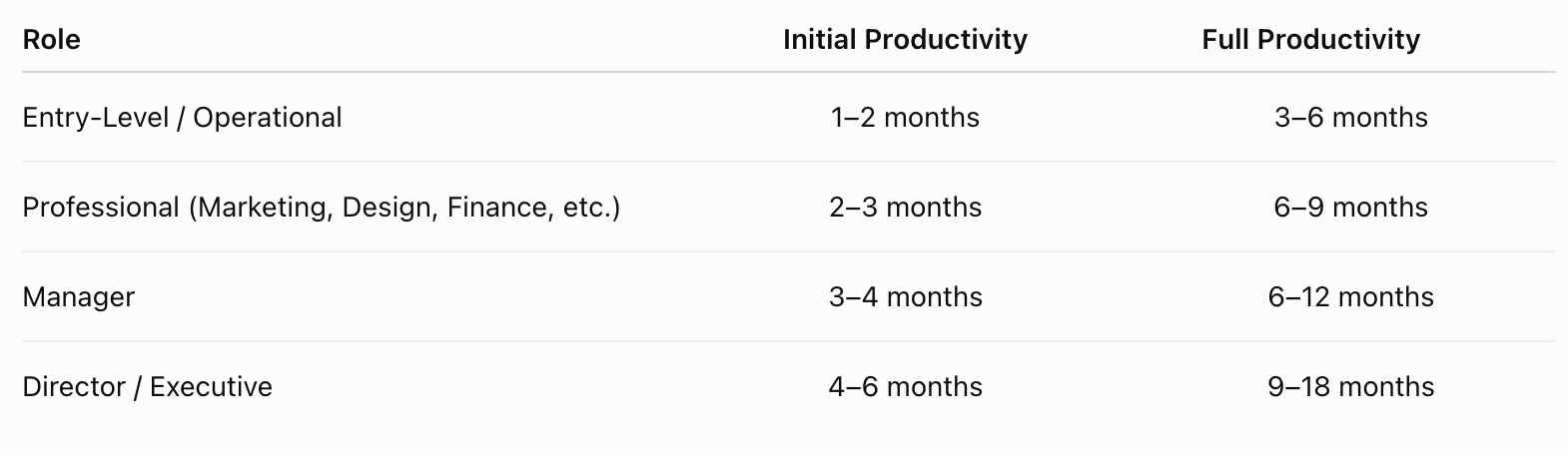
Estimated timeframes vary by industry, organizational complexity, and role. The ranges above reflect commonly used benchmarks in onboarding and talent management rather than fixed standards.
There is another possibility worth considering.
Perhaps organizations are not facing a different talent problem every year. Perhaps they are trying to solve a new problem with tools designed for a labor market that no longer exists.
Back in 2021, the conversation looked very different. We talked about the Great Resignation, remote work, mental health, virtual culture, and how to retain employees who suddenly had multiple job offers to choose from. Many organizations responded by strengthening their employer branding efforts, launching culture initiatives, introducing new benefits, or redesigning the employee experience for that particular moment.
Five years later, the questions have changed.
Why do candidates accept an offer and never show up?
Why do new hires leave within their first week?
Why does every new employee seem to stay for less time than the one before?
Why do agencies, vendors, and strategic partners also seem to change so frequently?
And yet many organizations continue responding with the same solutions.
A new logo.
A new tagline.
Another communication campaign.
More artificial intelligence.
Another culture initiative.
Not because any of these lack value, but because they may be addressing the symptoms rather than the problem itself.
Some time ago, I heard an observation that stayed with me: "Companies change agencies just as often as they change employees." At first, I thought it was about marketing. Over time, I realized it was about something much deeper. It was about an organization's relationship with time.
A company that constantly replaces employees, agencies, vendors, software platforms, strategies, or systems is not necessarily facing a different problem every few months. More often than not, it is experiencing the same problem repeatedly—only with different people involved.
In branding, we often say that trust is not built through a single great experience, but through consistency over time. Organizational culture works in remarkably similar ways. It is difficult to build trust when everything changes before it has the chance to mature.

Memory Sustains a Brand, Too
When we think about branding, we usually think of campaigns, positioning, visual identity, or reputation. Yet every brand has a far less visible dimension: its ability to deliver on its promise, over and over again. That consistency rarely depends on a logo. It depends on people.
It depends on customer-facing employees, product teams, managers, and decision-makers sharing a common understanding of how things are done—and why they are done that way. In other words, it depends on organizational memory.
That is why it is so difficult to separate employee turnover from the strength of a brand.
Every time an organization rebuilds a team, re-explains its processes, or reconstructs working relationships, it loses more than productivity. It also puts its ability to deliver a consistent experience at risk.
In branding, we often say that trust is rarely lost because of a single mistake. It erodes when the experience no longer matches the promise.
The same is true inside organizations.
Every company makes two promises.
The first is directed toward the market.
The second—often without ever being written down—is made to the people who choose to work there.
That promise begins long before the first day on the job. It takes shape during interviews, job offers, conversations with future leaders, and the expectations created throughout the hiring process.
When the promise aligns with everyday experience, the relationship has room to grow. When it does not, we often interpret an employee's departure as a recruitment problem. Perhaps it isn't. Perhaps we are witnessing a promise that was never fulfilled. And that distinction matters.
An organization can invest millions in strengthening its reputation in the marketplace while simultaneously weakening the experience of the people who sustain it from within. Sooner or later, those two stories inevitably converge.
It is remarkably difficult to build a strong brand externally when the experience inside the organization is forced to keep starting over.

The Cost of Forgetting
Employee turnover will probably never disappear. Nor should it. Organizations need fresh ideas, different perspectives, and people willing to question what has always been done the same way. Change, in itself, is not the problem.
The challenge begins when a company spends more time rebuilding than evolving.
When hiring stops being an investment and becomes a routine.
When teaching takes more time than learning.
When every departure forces the organization to start over before knowledge has had the opportunity to mature.
For years, we have treated attracting talent as one of the greatest challenges organizations face. Perhaps the more important question is a different one.
Are we building organizations capable of preserving enough knowledge to fulfill the promises they make?
Because a brand is not sustained by campaigns, strategies, or even a consistent visual identity alone. It is sustained by people who stay long enough to transform experience into judgment, judgment into culture, and culture into trust.
The most valuable asset an organization possesses has never been its employees alone. It has always been the collective memory they build together over time. And perhaps that is the most invisible cost of all. Not hiring once again.
But forgetting—again and again—who we are while trying to build a brand the world will remember.
